




Dr. Samsul Alam
Specialist (Analytical)
Research Areas
Monitoring of Pesticide Residues at National Level (MPRNL) Project
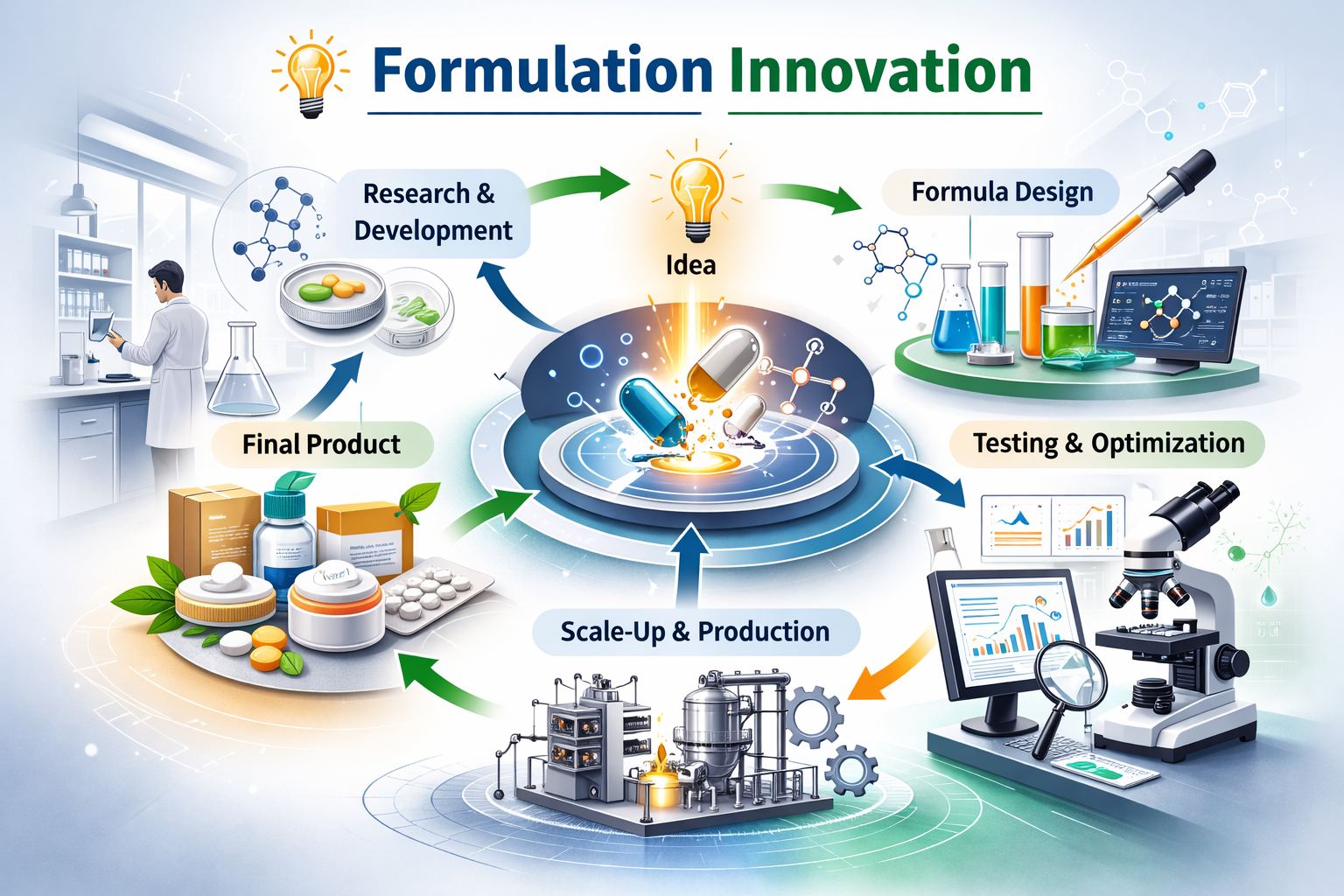
The Monitoring of Pesticide Residues at National Level (MPRNL) Scheme was initiated in 2005–06 by the Department of Agriculture, Cooperation & Farmers Welfare under the Ministry of Agriculture & Farmers Welfare, Government of India, as a Central Sector Scheme. The main objective of this program is to systematically monitor pesticide residues in various food commodities and environmental samples across the country to ensure food safety and environmental protection.
The scheme focuses on identifying high-risk areas that are more susceptible to pesticide contamination and on the regular analysis of food and environmental samples for the presence of pesticide residues. It also aims to strengthen quarantine facilities to ensure compliance with national and international regulatory standards. In addition, the program monitors export and import consignments to maintain international quality requirements. The scheme further encourages the adoption of Integrated Pest Management (IPM) and Good Agricultural Practices (GAP) in order to reduce excessive pesticide usage and minimize residue levels in agricultural produce.
Under this monitoring program, samples are collected from different districts of Haryana at both farm-gate level and market level. The collected samples mainly include fruits, vegetables, cereals, pulses, and spices, which are analyzed for pesticide residue levels.
Deciphering Agricultural Soil Microbes for Sustainable Management of Lignocellulosic Waste and Bioremediation of Chlorpyrifos (DT50) contaminated sites
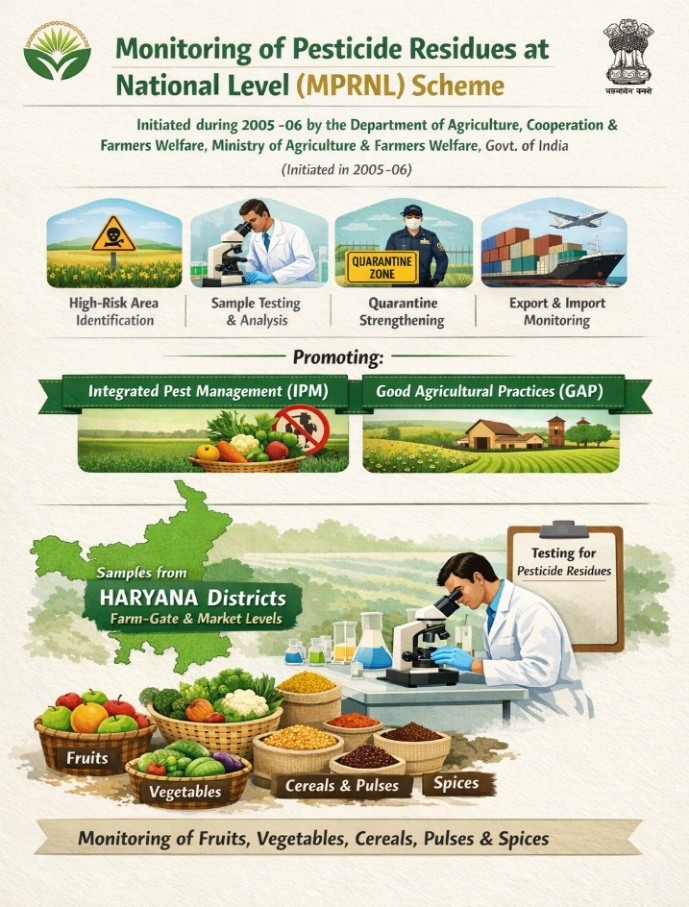
This research focuses on the determination of Chlorpyrifos and its major metabolites residues in soil and water samples collected from different regions using advanced analytical techniques such as LC–MS/MS and GC–MS/MS. This research work is being carried out under a project supported by the National Agricultural Science Fund (NASF) of the Indian Council of Agricultural Research (ICAR). The screening of soil samples will assist in identifying suitable soils for the development of a microbial consortium intended for biodegradation studies.
The study also aims to evaluate the degradation pattern of Chlorpyrifos in samples treated with the microbial consortium, which will be monitored using GC–MS/MS. In addition, the research includes the optimization of analytical methods for the detection and quantification of Chlorpyrifos and its major metabolites, such as Chlorpyrifos-oxon, Chlorpyrifos methyl, 3,5,6-trichloro-2-pyridinol (TCP), diethyl phosphate (DEP), and diethyl thiophosphate (DETP) using GC–MS/MS and LC–MS/MS techniques. Furthermore, the developed analytical methods will be validated by evaluating important parameters including precision, accuracy, sensitivity, linearity, and reproducibility to ensure reliable and accurate results.
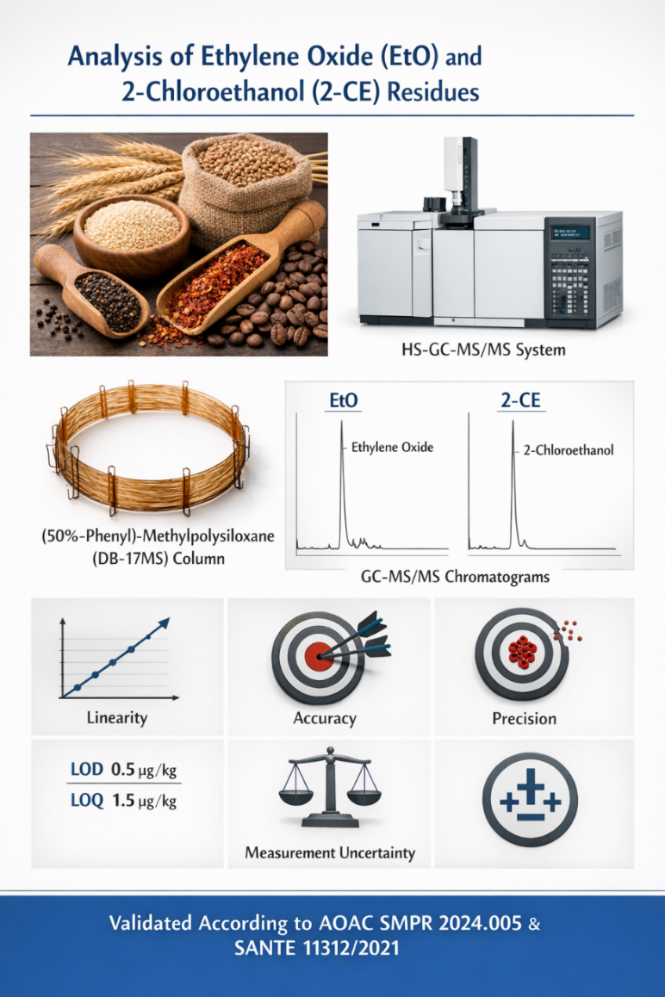
Determination of ethylene oxide and its marker residue 2-chloroethanol in food matrices
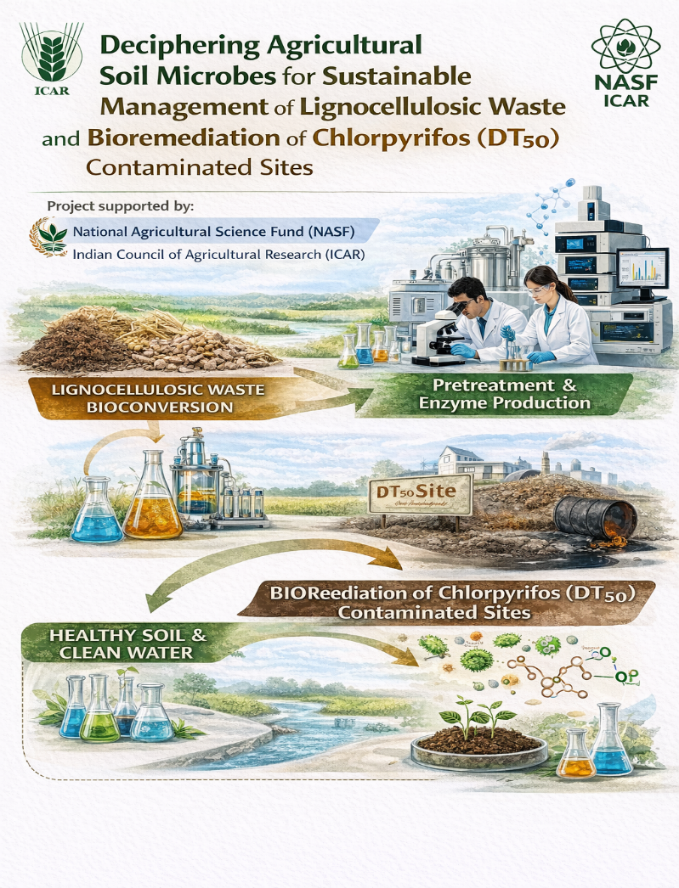
A single-laboratory investigation was conducted to optimize and validate a method for the determination of ethylene oxide (EtO) and its marker residue, 2-chloroethanol (2-CE), in wheat, sesame seeds, chilli flakes, and coffee according to the AOAC International Standard Method Performance Requirements (SMPRS®) 2024.005. A rapid temperature-controlled extraction method coupled with HS-GC–MS/MS was optimized and validated for the simultaneous analysis of EtO and 2-CE residues. The method employs a cost-effective (50%-phenyl)-methylpolysiloxane (DB-17MS) capillary column as an alternative to the more expensive WAX column. Method performance characteristics, including linearity, accuracy, precision, limit of detection (LOD), limit of quantification (LOQ), and measurement uncertainty, were evaluated according to the SANTE 11312/2021v2 guidelines and were found to meet the requirements specified in AOAC SMPR 2024.005.
Quality Control and Regulatory Monitoring
Quality Control and Regulatory Monitoring at the Institute of Pesticide Formulation Technology (IPFT) play a vital role in ensuring the safety, quality, and compliance of pesticide formulations and food products with national and international standards in accordance with ISO/IEC 17025:2017. The standard emphasizes the implementation of a comprehensive quality management system that includes method validation, calibration of instruments, use of certified reference materials, participation in proficiency testing, and routine quality control checks. Laboratories must establish documented procedures for sample handling, data processing, and result reporting to maintain technical competence and consistency. The institute conducts systematic analysis of pesticide residues, contaminants, and formulation components using advanced analytical techniques such as GC–MS/MS and LC–MS/MS. In addition, regulatory monitoring involves assessing pesticide residues in food, soil, and environmental samples to ensure compliance with maximum residue limits (MRLs) and safety regulations. Through rigorous analytical testing and adherence to quality assurance practices, IPFT contributes to safeguarding public health, environmental protection, and the development of reliable pesticide formulations.

Group Head

Dr. Samsul Alam
Specialist (Analytical)
Dr. Samsul Alam is an experienced analytical scientist currently working as Specialist (Analytical) at the Institute of Pesticide Formulation Technology (IPFT), Gurugram, India, with more than 18 years of research experience in analytical chemistry related to pesticides, environmental contaminants, and heavy metals. He obtained his Ph.D., M.Sc., and B.Sc. in Agricultural Chemicals from Bidhan Chandra Krishi Viswavidyalaya, West Bengal. His research focuses on analytical method development and validation, pesticide residue analysis, environmental monitoring, heavy metal speciation, impurity profiling, and certified reference materials. He is empanelled as Lead Assessor and Technical Assessor with the National Accreditation Board for Testing and Calibration Laboratories (NABL) and has served as Academic Counsellor for the Post Graduate Diploma in Analytical Chemistry at Indira Gandhi National Open University (IGNOU). He has received recognition at national and international scientific forums for his contributions to analytical chemistry and pesticide residue research. His professional contributions include invited lectures, technical consultancy for government projects, and academic counseling at IGNOU. He has supervised postgraduate and doctoral students and has authored numerous peer-reviewed publications in reputed international journals, along with book chapters and patents, demonstrating significant contributions to analytical science, regulatory research, and environmental safety.
Scientific Staff
Ph.D Students
Project Personnel

Ms. Poornima
Poornima is a skilled analytical chemistry professional with over 12 years of experience in laboratory research, analytical testing, and environmental and food safety studies. She is currently working as a Research Associate at the Institute of Pesticide Formulation and Technology (IPFT), Gurugram under the MPRNL project, where she also serves as study personnel under the GLP system. She has previously worked at Indian Agricultural Research Institute (IARI), New Delhi, and the Centre for Science and Environment (CSE), New Delhi, contributing to research on pesticide residues, food toxins, environmental contaminants, and public health issues. Her expertise includes analytical method development and validation, pesticide formulation analysis, laboratory auditing, and ISO/IEC 17025 quality systems. She has hands-on experience with advanced analytical instruments such as LC-MS/MS, GC-MS/MS, HPLC, UHPLC, AAS, SEM, and UV-VIS spectrophotometers. Poornima holds M.Phil. and M.Sc. degrees in Chemistry from Dr. B.R. Ambedkar University, Agra, and is currently pursuing a Ph.D. from Banasthali Vidyapith University. She has also contributed to scientific publications, technical reports, conferences, and laboratory training programs, reflecting her strong background in analytical chemistry, food safety, and environmental monitoring.

Ms. Sandhya Kaushik
Sandhya Kaushik is a motivated analytical chemist with experience in pesticide residue analysis, food and water testing, and regulatory laboratory practices. She is currently working as Young Professional–II at the Institute of Pesticide Formulation Technology (IPFT) under NASF project, Gurugram, where she contributes to standardization, quality assurance, and conformity assessment activities, with a strong focus on ISO/IEC 17025:2017 and GLP compliance. She has previously worked as a Project Associate at IPFT, performing pesticide residue a nd heavy metal analysis using advanced analytical instruments such as GC-MS, LC-MS/MS, ICP-MS, HPLC/UPLC, and UV-VIS spectroscopy. She also gained industry exposure as a Research Trainee at Teva Pharmaceuticals, where she worked on method development, impurity profiling, stability studies, and analytical documentation. Sandhya holds an M.Sc. in Chemistry from J.C. Bose University of Science and Technology and a B.Sc. (Hons.) in Chemistry from Shaheed Rajguru College of Applied Sciences for Women. Her expertise includes method validation, analytical testing of pesticide formulations, technical documentation, and laboratory quality systems, supported by training in ISO/IEC 17025 and GLP standards, making her well equipped for roles in analytical laboratories and regulatory quality assurance.

Ms. Sakshi Singhal
Sakshi Singhal is currently working as a Young Professional–II under the MPRNL project. She completed her Bachelor of Science (B.Sc.) from Kurukshetra University and her Master of Science (M.Sc.) from the Central University of Haryana. At the Institute of Pesticide Formulation Technology (IPFT), she is engaged in research and analytical activities related to pesticide formulations and pesticide residue monitoring in food and environmental samples. Her work involves sample preparation, method implementation, instrumental analysis, and interpretation of analytical data for the detection and quantification of pesticide residues and heavy metals. She has hands-on experience with advanced analytical instruments, including Ultra-Fast Liquid Chromatography (UFLC), Gas Chromatography with Flame Ionization Detector (GC-FID), Gas Chromatography–Tandem Mass Spectrometry (GC–MS/MS), Liquid Chromatography–Tandem Mass Spectrometry (LC–MS/MS), and Inductively Coupled Plasma Mass Spectrometry (ICP–MS). She has contributed to the analysis of various food commodities and environmental matrices such as fruits, vegetables, spices, rice, water, and soil, supporting studies related to food safety, environmental monitoring, and regulatory compliance. Her research interests include pesticide residue analysis, analytical method development, food safety evaluation, and environmental contaminant monitoring. Through her work, she contributes to scientific efforts aimed at strengthening food safety systems and supporting regulatory and environmental quality standards.

Mr. Manish Kumar
Manish Kumar is an early-career laboratory professional with a Master’s degree in Chemistry from CSJM University, Kanpur, and practical experience in analytical laboratory operations. He is currently working at the Institute of Pesticide Formulation Technology (IPFT), Gurugram, where he serves as Young Professional-I in the MPRNL project and Deputy TICO In-charge, after previously working as a Lab Assistant in the same project. His work involves pesticide residue extraction from food, water, and soil samples, pesticide formulation testing, and maintenance of laboratory records in compliance with NABL and GL P guidelines. Manish has hands-on experience with several analytical instruments including GC-MS/MS, LC-MS/MS, GC-FID, GC-MS, and HPLC/UFLC, along with routine laboratory equipment. He is skilled in sample preparation, chemical handling, laboratory safety practices, equipment operation, and analytical documentation, demonstrating a strong interest in laboratory research, quality standards, and environmental and food contaminant analysis.
Interns / Trainees
Alumni

OECD GLP certification of IPFT: Physical-Chemical studies including five batch analysis and Residue analysis. IPFT has become the First Govt. GLP Laboratory in the country for physical-chemical param
OECD GLP certification of IPFT: Physical-Chemical studies including five batch analysis and Residue analysis. IPFT has become the First Govt. GLP Laboratory in the country for physical-chemical parameters, pesticide residue and Five batch analysis.
NABL accreditation with enhanced scope: ISO/IEC 17025: 2017 with the scope for 278 pesticides in residue scope and 150 pesticide products (approx.) in formulation scope.
NABL accreditation with enhanced scope: ISO/IEC 17025: 2017 with the scope for 278 pesticides in residue scope and 150 pesticide products (approx.) in formulation scope.
Central Insecticide Board (CIB)/Registration Committee (RC) Recognition by CIB/RC for testing of pesticide for bio-efficacy and phyto-toxicity studies for registration purpose.
Central Insecticide Board (CIB)/Registration Committee (RC) Recognition by CIB/RC for testing of pesticide for bio-efficacy and phyto-toxicity studies for registration purpose.

APEDA, New Delhi: Recognized by APEDA, New Delhi for testing of pesticide residue in food commodities for export purpose.
APEDA, New Delhi: Recognized by APEDA, New Delhi for testing of pesticide residue in food commodities for export purpose.
The lab is Recognised by DSIR.
The lab is Recognised by DSIR.
Completed
MPRNL Project is funded by Ministry of Agriculture & Farmers Welfare, Government of India.
NASF Project is being carried out by the National Agricultural Science Fund (NASF) of the Indian Council of Agricultural Research (ICAR).
Ongoing
Selected Publications
-
Chaturvedi, M., Kaur, N., Alam, S., & Sharma, S. (2025). Sustainable approach for degradation of low-density polyethylene plastic waste using ligninolytic white rot fungus. Journal of Basic Microbiology, 65(4), e2400442. https://doi.org/10.1002/jobm.202400442 (Impact Factor: 3.5)
-
Anil, A. S., Alam, S., & Thakur, L. K. (2024). Optimized mercury speciation analysis using LC-ICP-MS and microwave-assisted extraction for precise determination of methylmercury in fish, rice, and soil. Journal of Food Composition and Analysis, 129, 106092. https://doi.org/10.1016/j.jfca.2024.106092 (Impact Factor: 4.6)
-
Kumar, V., Mishra, S., Alam, S., & Thakur, L. K. (2025). Levels of chlorpyrifos, ethion, lambda-cyhalothrin, pendimethalin, and triazophos pesticide residues in vegetables. Journal of Food Composition and Analysis, 137, 106853. (Impact Factor: 4.6)
-
Devi, O. Z., Mishra, S., Alam, S., & Thakur, L. K. (2025). Single-quadrupole gas chromatography estimation of selected pesticide residues in spices from the National Capital Region of Delhi. Environmental Monitoring and Assessment, 197(4), 1–11. (Impact Factor: 3.0)
-
Mishra, S., Kumar, V., Singh, M. K., Saini, M. K., Alam, S., Kasana, P., Saloni, & Thakur, L. K. (2025). Monitoring and risk assessment of pesticide residues in vegetables, soil, and water in Haryana, India. Environmental Science and Pollution Research, 32(13), 8358–8377. https://doi.org/10.1007/s11356-025-36218-5 (Impact Factor: 6.2)
Opportunities
IPFT provides diverse opportunities for employees, trainees, and students to enhance their knowledge, technical skills, and professional development. Employees benefit from a collaborative scientific environment where they can engage in advanced research projects, use modern analytical instruments, publish research papers, and participate in national and international conferences and workshops. Trainees and interns gain valuable hands-on experience through laboratory training, exposure to research methodologies, and participation in real-time experimental work under the guidance of experienced scientists. For students, IPFT offers internships, dissertation projects, and training programs that help them understand scientific concepts, experimental design, and data interpretation. These opportunities not only strengthen technical competence but also encourage innovation, critical thinking, teamwork, and problem-solving skills, thereby preparing individuals for successful careers in academia, industry, and regulatory sectors.